 how-to
How to Remove Sulfur Smell From Well Water
Table of Contents
- Step 1: Confirm the Sulfur Smell Comes From Your Well, Not Your Water Heater
- Step 2: Well Water Testing for Sulfur and Hydrogen Sulfide Levels
- Step 3: Shock Chlorination for Sulfur Bacteria in the Well
- Step 4: Aeration vs Chlorination: Choosing an Oxidation System
- Step 5: Water Heater Anode Rod Replacement for Sulfur Smell
- Step 6: What Sulfur Treatment Really Costs Long Term
- Common Mistakes to Avoid When Treating Sulfur Smell
- Frequently Asked Questions
Last Updated: September 20, 2026
Step 1: Confirm the Sulfur Smell Comes From Your Well, Not Your Water Heater
Before you spend money on treatment, learn how to remove sulfur smell from well water by finding out where the rotten egg odor starts. That smell is hydrogen sulfide gas, and it can enter your water from two very different places. Fixing the wrong one wastes time and money.
The quick two-tap test
Fill a glass from a cold tap. Fill another from a hot tap. Step away for a few minutes, then smell both.
- Cold water smells: The sulfur is in your well or plumbing. Keep reading.
- Only hot water smells: The problem is your water heater. Skip to Step 5.
- Both smell: You likely have sulfur in the well plus a reaction in the heater.
Step 2: Well Water Testing for Sulfur and Hydrogen Sulfide Levels
Well water testing for sulfur gives you the numbers you need to pick the right fix. You cannot choose a treatment system on smell alone.
Hydrogen sulfide vs. sulfur bacteria
The two problems look alike but need different fixes. Here's the difference:
Clue | Hydrogen Sulfide Gas | Sulfur Bacteria |
|---|---|---|
Smell | Rotten egg odor, constant | Rotten egg odor, often worse over time |
Slimy film | No | Yes, in tanks and toilet bowls |
Well casing | Clean | Orange or black slime |
Best first step | Oxidation system | Shock chlorination |
Step 3: Shock Chlorination for Sulfur Bacteria in the Well
The process is straightforward but must be done carefully:
- Pour the well with the correct amount of chlorine, based on your well's diameter and depth.
- Recirculate the water until you smell chlorine at every tap.
- Let it sit in the lines for at least 12 hours.
- Flush the system until the chlorine clears.
- Retest after two weeks.
Shock chlorination is a reset, not a cure. If your well keeps growing bacteria, you have a source problem, and you will need ongoing treatment.
Step 4: Aeration vs Chlorination: Choosing an Oxidation System
Aeration vs chlorination is the core decision for dissolved hydrogen sulfide. Both oxidize the gas so it can be removed, but they fail under different water conditions. The right pick depends on your test numbers, not on which system a salesperson prefers.
How each method actually works
Aeration introduces air into the water, strips the dissolved hydrogen sulfide into a gas, and vents it outdoors. No chemicals enter the water. The two common designs are:
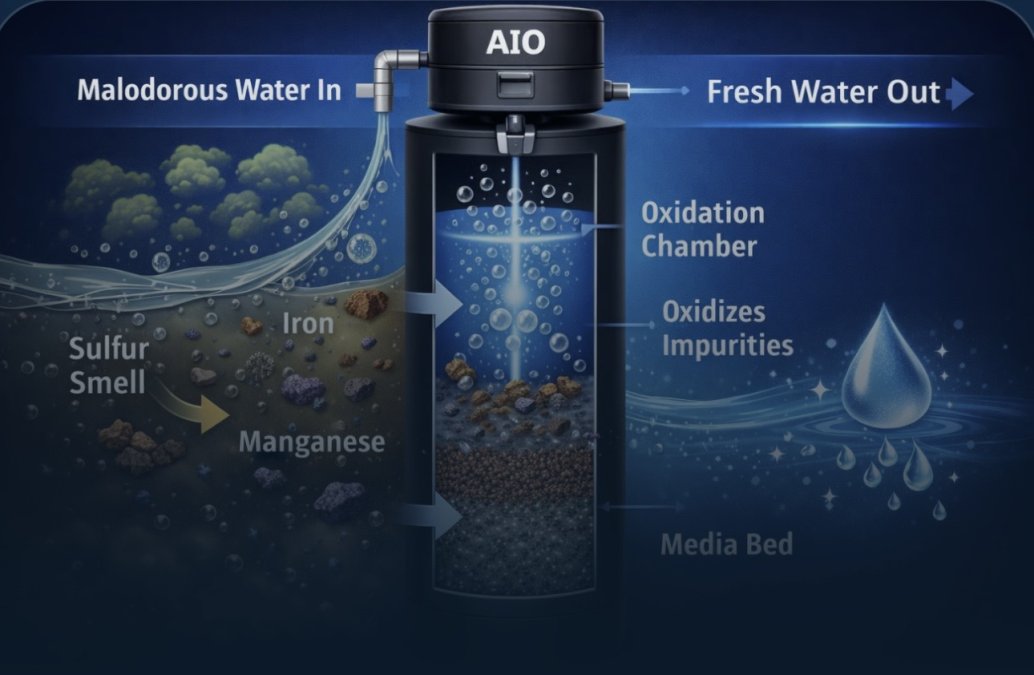
- Air injection oxidation (AIO) filters, a pump pulls air into a mixing tank, the water cascades over media, and the gas vents through a dedicated line. The unit backwashes on a set schedule to clear the media bed.
- Packed-tower or forced-draft aerators, water sprays down through a column of air, then drops into a holding tank. These handle higher gas loads but take up more floor space and need a drain.
Matching the system to your test result
Your water test shows | Best first choice | Why |
|---|---|---|
H2S under ~1 mg/L, no iron, no slime | Carbon filter or AIO | Low load, no chemicals needed |
H2S 1-5 mg/L, clear water | AIO filter | Handles moderate gas without consumables |
H2S above ~5 mg/L, or iron above ~1 mg/L | Peroxide or chlorine injection | Aeration alone can't keep up; oxidant does the heavy lifting |
H2S plus sulfur bacteria slime | Shock chlorination first, then AIO or injection | Kill the colony, then treat the gas |
H2S plus manganese above ~0.05 mg/L | Chemical injection | Manganese needs a stronger oxidant than air |
Aeration can struggle once iron climbs past about 1 mg/L, because the iron can foul the media bed faster than backwashing can clear it. If your test shows both, chemical injection may be a more suitable option from the start.
Air injection oxidation (AIO) filters
AIO units are the default for most homes with moderate gas and clean water. They pull in air, mix it with your water, and vent the gas outside. The upside: no chemicals to buy, store, or handle. The catch: they need a vent to the outside, they use extra water during backwashing (often 50-100 gallons per cycle), and the media bed needs periodic replacement.
Hydrogen peroxide injection systems
Hydrogen peroxide injection handles higher gas levels and stubborn water. A metering pump drips peroxide into the line, oxidizing sulfur fast. It also knocks down iron and manganese in the same pass, which is why it's the go-to when your test shows multiple problems. The trade-off is ongoing cost, you keep buying peroxide, plus a pump and controls that need annual service.
Hydrogen sulfide in drinking water, treatment guidance
Step 5: Water Heater Anode Rod Replacement for Sulfur Smell
Water heater anode rod replacement is the fix when only your hot water smells. The rod is a metal bar inside the tank that protects it from rust. When it reacts with sulfur in the water, it creates that rotten egg odor.
The fix is simple:
- Turn off the power or gas and the water supply.
- Drain a few gallons to lower the water level.
- Remove the old rod and install an aluminum or powered rod.
- Refill, then flush the tank.
Step 6: What Sulfur Treatment Really Costs Long Term
Long-term cost is where most guides go quiet. The sticker price is only part of the story, the five-year total is what actually matters, and it varies widely by system type. Here's how to think about it.
The five cost buckets
Every sulfur treatment system has the same five cost lines. Compare systems on all five, not just the install quote:
- Equipment and installation, one-time. Includes the unit, plumbing changes, venting, drain lines, and labor.
- Consumables, recurring. Chlorine, peroxide, or replacement media. Aeration uses none; injection systems use the most.
- Water, recurring. Backwashing and regeneration cycles send treated water down the drain. Aeration and AIO units are the heaviest users.
- Power, recurring. Pumps, metering pumps, and control valves draw a small but constant load.
- Service and parts, recurring. Annual inspections, pump rebuilds, valve replacements, and media changes.
How the systems compare over five years
System | Upfront | Consumables | Water use | Service |
|---|---|---|---|---|
Carbon filter | Low | Media every 2-3 years | Low | Low |
AIO filter | Moderate | None | High (backwash) | Moderate |
Peroxide injection | Moderate-high | Peroxide, ongoing | Low | Moderate-high |
Chlorine injection | Moderate | Chlorine, ongoing | Low | Moderate |
Packed-tower aeration | High | None | Moderate | Moderate |
A common pattern is that the cheapest system to install is rarely the cheapest to own. Carbon filters look inexpensive up front, but if your gas level is high, the media loads up fast and you'll be replacing it more often than the schedule suggests. Peroxide injection costs more per month in chemicals but handles water that would destroy a carbon bed in a year.
The hidden costs nobody quotes
- Pre-treatment. If your water is acidic or high in iron, you may need a neutralizer or iron filter ahead of the sulfur system. That's a second unit, a second install, and a second maintenance schedule.
- Retesting. Plan on a lab test after installation and again at the one-year mark. If the numbers drift, the system needs adjustment.
- Disposal. Spent carbon and greensand media have to go somewhere. Check local rules before you dump a backwash line or haul media to the curb.
- Water heater wear. Sulfur and the bacteria that produce it shorten anode rod life. Budget for more frequent rod changes even after the water is treated.
How to get a real number
Ask for a five-year cost estimate in writing, broken out by the five buckets above. A quote that only lists the equipment price is not a quote, it's a down payment. Pricing depends on your water test, home size, fixture count, and system type, so the only accurate number comes from your own test results.
Common Mistakes to Avoid When Treating Sulfur Smell
The biggest mistake in how to remove sulfur smell from well water is treating before testing. You cannot pick a system on smell alone.
Other common errors:
- Shocking a well without fixing the bacteria's food source.
- Installing a carbon filter for high gas levels. It clogs fast.
- Ignoring the water heater when only hot water smells.
- Skipping the vent on an aeration unit, which traps gas indoors.
- Forgetting to retest after treatment.
Frequently Asked Questions
What is the cheapest way to remove sulfur smell from well water?
Shock chlorination is the least expensive starting point. It costs only the price of chlorine granules and a few hours of your time, and it often clears sulfur bacteria from the well casing and plumbing. If the rotten egg odor returns within weeks, the problem is likely hydrogen sulfide gas in the water itself, which needs a treatment system like aeration or chemical injection. Start with testing before spending on equipment.
Is it safe to drink or shower in well water that smells like sulfur?
Hydrogen sulfide at the levels that cause a rotten egg odor is not usually a health hazard, but it can make water unpleasant and may corrode plumbing. Sulfur bacteria are generally harmless to drink, though they can coat fixtures and feed iron bacteria. Because well water can carry other contaminants, have a certified lab test your water for sulfur and other issues before deciding it is safe.
Does a water softener remove sulfur smell?
No. A water softener treats hardness minerals like calcium and magnesium, not dissolved hydrogen sulfide gas or sulfur bacteria. Some homeowners run a softener after a sulfur treatment system to handle hardness, but the softener itself will not fix the smell. You need oxidation, aeration, or filtration designed for sulfur, not ion exchange alone.
How do I know if the sulfur smell is coming from my water heater?
Run cold water at a kitchen tap and smell it. If the cold water smells fine but the hot water smells like rotten eggs, the problem is in your water heater. The magnesium anode rod can react with sulfate in the water to produce hydrogen sulfide. Replacing the anode rod with an aluminum or zinc rod, or removing it, often fixes the smell. If both hot and cold water smell, the sulfur is in the well.
Sulfur smell is stubborn, but it is fixable once you know the source. Water Treatment Systems designs custom systems for well water conditions, starting with a free water analysis and testing. Our certified technicians handle installation and ongoing support, so you get clean, odor-free water without the guesswork. Request your free water analysis and get rid of that rotten egg smell for good.