 blog
7 Whole House Water Filter Facts Missouri Homeowners Need
Last Updated: November 5, 2026
Quick Summary
A whole house water filter is installed where the main water line enters the home, so every tap, shower and appliance receives treated water. Most standard systems combine sediment and carbon filtration to reduce sediment, chlorine, taste and odor, but they do not soften hard water. Testing your water first shows which contaminants you need to treat.
- A whole house water filter treats water before it branches to the rest of the house.
- Standard sediment-and-carbon systems will not soften hard water.
- Carbon stages reduce chlorine, taste and odor in city water.
- Well water often needs testing for sulfur, iron and sediment before choosing media.
- Compare quotes by equipment, installation, replacement media and service life.
Table of Contents
- What a Whole House Water Filter Actually Treats
- Whole House Water Filter for City Water: Chlorine, Taste and Odor
- Whole House Water Filter System for Well Water: Sulfur, Iron and Sediment
- Whole House Water Filter Price: What Installed Systems Typically Cost
- Whole House Water Filter Replacement: Cartridge Intervals and Ongoing Costs
- Testing Your Water Before Choosing a Whole House Filter in Missouri
- Booking Your Free Water Analysis
- Frequently Asked Questions
If you have ever wondered why the water in your Missouri home tastes like a swimming pool or smells faintly of rotten eggs, you are not alone. For a broader overview, see how to get soft water at home.
A whole house water filter is a point-of-entry device installed where the main water line enters the house, so that treated water reaches every faucet, shower and appliance.
What a Whole House Water Filter Actually Treats
A whole house water filter is installed on the main supply line, usually in a basement, utility room or garage. It treats water before it branches out to the rest of the house, which is why it is called point-of-entry treatment. A point-of-use filter, by contrast, sits under one sink or on one faucet and only treats that outlet.
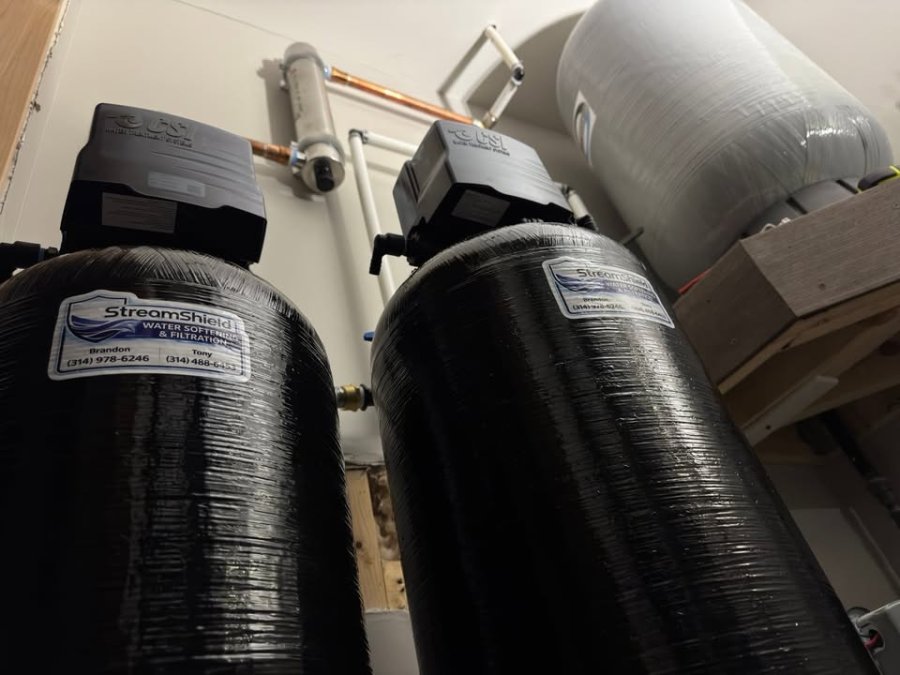
Point-of-entry treatment and where it sits on the main line
Because the filter sits at the entry point, the water going to the water heater, washing machine, dishwasher and every shower is already treated. This matters most for bathing and laundry, where you would otherwise be exposed to chlorine or sediment through the skin and air rather than through drinking alone.
Placement also affects maintenance. Most systems need a clear, accessible spot with room to swap cartridges and a drain or nearby floor drain for backwash or bypass valves. Plan for that before buying.
Contaminants filters reduce and what they do not treat
Whole house filters typically combine sediment filtration with carbon filtration. Sediment stages catch sand, rust and silt. Carbon stages reduce chlorine, improve taste and odor, and can reduce some organic compounds. Some systems add specialty media for specific problems.
What they do not treat is equally important. A standard sediment-and-carbon system will not soften hard water, so it does not stop scale on water heaters and fixtures.
Whole House Water Filter for City Water: Chlorine, Taste and Odor
Most Missouri homes on municipal supply are dealing with chlorine taste, chlorine odor, and sometimes disinfection byproducts. Carbon media is the main tool here, and it works well when the cartridge is sized for the home's flow rate and changed on schedule.
The practical test is simple: if the water tastes fine at the kitchen tap but smells of chlorine in the shower, a whole house system is likely to solve the problem.
Whole House Water Filter System for Well Water: Sulfur, Iron and Sediment
Well water brings different problems. Sulfur odor, often described as rotten eggs, usually comes from hydrogen sulfide gas. Our guide to removing sulfur smell from well water covers testing, aeration and chlorination fixes. Iron and manganese cause staining on fixtures and laundry.
A standard carbon filter may reduce the smell, but it can mask rather than fix the source, and carbon media can become a breeding ground for bacteria if it is not maintained. For well water, the right answer depends on what testing reveals.
Whole House Water Filter Price: What Installed Systems Typically Cost
Most pricing pages stop at a sticker price. The more useful number is total cost of ownership: what you pay to buy the system, what it costs to install it correctly, and what you spend on replacement media over its service life.
The four cost buckets to compare
Every whole house filter quote should be broken into the same four buckets so systems can be compared on equal terms:
Request My Free Water Analysis →
- Equipment: the housing, bypass valve, mounting bracket, and initial filter media. Multi-stage and specialty-media systems cost more than a single sediment cartridge housing, and the gap is driven by media volume and housing size, not brand.
- Installation: plumbing labor, fittings, shutoff valves, drain connections for backwashing systems, and any permit required by the local authority. Installation on an accessible main line with existing shutoffs is the cheapest case; relocating a line, adding a drain, or correcting old plumbing adds labor.
- Replacement media: sediment cartridges, carbon cartridges or tanks, and specialty media. This is the cost that recurs, and it is the one most shoppers underestimate.
- Service life and disposal: how many years the housing and valve last before replacement, and whether spent media can go in the trash or needs special handling.
What drives the price up or down
A few variables explain most of the spread between quotes:
- Flow capacity. A system sized for a small household with one bathroom costs less than one sized for a large home with multiple simultaneous showers and heavy laundry use. Undersizing to save money is the most common false economy because the filter cannot keep up with demand.
- Number of stages and media type. Sediment-only is the least expensive. Carbon block, granular activated carbon, catalytic media for hydrogen sulfide, and oxidation systems for iron each add cost.
- Backwashing versus cartridge. Backwashing systems use a control valve and need a drain, which raises installation cost but can extend media life. Cartridge systems are cheaper to install but push cost into frequent cartridge changes.
- Water chemistry. Well water with iron, manganese, or sulfur often needs pretreatment or specialty media, which raises both equipment and media cost.
How to read a quote
Ask every installer to itemize the four buckets above and to state the assumed replacement interval for each media type. A low equipment price paired with a short replacement interval can cost more over five years than a higher-priced system with longer media life. Ask for the cost per 1,000 gallons treated as a sanity check, and confirm whether the quote includes the bypass valve, the initial media, labor, and any drain or permit work. A quote that omits the bypass valve is not a complete quote.
Whole House Water Filter Replacement: Cartridge Intervals and Ongoing Costs
Replacement is where a whole house filter either earns its keep or quietly stops working. The housing and valve can last for years, but the media is consumable, and exhausted media can be worse than no filter at all if it harbors bacteria or sheds captured material.
What actually determines the replacement interval
Manufacturers publish a schedule, but the real interval depends on three variables:
- Volume treated. A household of two using 60 gallons per person per day treats far less water than a family of five with a home office and daily laundry. Size the interval to gallons, not just months.
- Contaminant load. City water with moderate chlorine lets carbon last longer than well water with iron, sulfur, or heavy sediment. Sediment cartridges in well water homes often need changing several times more often than in municipal homes.
- Media type. Sediment cartridges are the cheapest and most frequent change. Carbon block and granular carbon last longer but degrade silently. Specialty media for iron or sulfur has its own regeneration or replacement cycle.
Signs the media is exhausted
Do not rely on the calendar alone. These are the practical signals:
- Chlorine taste or smell returns at the tap, especially in the shower.
- Water pressure at fixtures drops noticeably, suggesting a clogged sediment stage.
- Sediment is visible in toilet tanks or on fixtures after the filter.
- Water develops an earthy or sulfur odor that was not there before.
- The cartridge housing shows bypass or channeling, where water has found a path around the media.
Maintenance tasks beyond cartridge swaps
A whole house system needs more than new cartridges:
- Bypass valve check. Confirm the bypass is fully closed in normal operation and opens freely during service. A partially open bypass lets untreated water mix with treated water.
- O-ring and housing inspection. Lubricate or replace O-rings at each change to prevent leaks, and inspect the housing for cracks.
- Pressure monitoring. Install a pressure gauge before and after the filter. A growing pressure drop across the filter is the clearest early signal that media needs changing.
- Sanitization after long idle periods. If the system sat unused, sanitize the housing per the manufacturer's instructions before returning it to service, especially on well water.
- Backwash scheduling. Backwashing systems need the control valve set correctly for the media and water chemistry; a wrong backwash cycle wastes water and shortens media life.
Troubleshooting common problems
- Leaks at the housing: usually a pinched or dry O-ring, or a housing not tightened to the manufacturer's specification. Hand-tighten only as directed.
- Low pressure after installation: check for a clogged sediment stage, an undersized system, or a partially closed valve.
- Filter clogs too fast: the sediment stage is doing its job; step up to a larger housing or a coarser pre-filter rather than changing cartridges more often.
- Taste returns early: the carbon stage is undersized for the flow rate, or the system is being bypassed.
The table below summarises the signs that a whole house filter's media needs attention.
Signal | What it means | Action |
|---|---|---|
Chlorine taste or smell returns | Carbon stage is exhausted or undersized | Replace carbon media |
Pressure drops at fixtures | Sediment stage is clogged | Change sediment cartridge |
Sediment visible in toilet tanks | Filter is no longer capturing particles | Inspect and replace cartridge |
Earthy or sulfur odor appears | Media is spent or has harbored bacteria | Replace media and sanitize housing |
Water bypasses the media | O-rings or housing are failing | Inspect and lubricate or replace O-rings |
Testing Your Water Before Choosing a Whole House Filter in Missouri
Testing first prevents most expensive mistakes. Use a testing-first guide to well water filtration to decide whether your home needs treatment at all. Learn whether professional water analysis is worth it compared with DIY kits and what each can detect.
If you have a private well, testing matters even more, because the water supply is not regulated the way municipal water is (the EPA). Keep the results on file, since they are useful for choosing the system and for monitoring performance over time.
Booking Your Free Water Analysis
The fastest way to know whether a whole house water filter fits your home is to start with a water analysis. Water Treatment Systems offers a free water analysis to Missouri homeowners to identify hard water, chlorine, iron, manganese and sulfur issues. Request your free water analysis today to learn more about your water.
Frequently Asked Questions
Is a whole house water filter worth it?
It depends on your water source and what you need to remove. A whole house system treats water at every tap, so it addresses sulfur odor, iron staining, sediment, and chlorine throughout the home rather than at a single faucet. Pitcher and faucet filters only treat the water they touch. A water test can help you determine whether the investment fits your situation. Households on city water with mainly taste concerns may get enough benefit from a smaller point-of-use setup. A water test is the most reliable way to decide.
What is the average cost of a whole house water filter system?
Final cost depends on the system type, the contaminants being treated, the flow capacity needed for the home, and installation complexity. Pricing for Water Treatment Systems depends on quantity, the home's water conditions, and scheduling, so request a quote from the company directly for current pricing.
How often should you replace a whole house water filter cartridge?
Replacement timing also depends on water volume, the level of sediment or iron in the supply, and the manufacturer's rated capacity. Some systems are rated for much longer service, so check the specific cartridge or media specification. Tracking water use and watching for drops in water pressure helps you decide when a change is due.
Can a whole house water filter remove chlorine, iron, or sulfur odors?
Whole house systems can address chlorine and sulfur odor through carbon-based media, and iron through appropriate media and sediment filtration. Performance varies by system, so a claim of removal should be checked against certified contaminant performance data. A water test identifies which contaminants are present and at what levels, which determines whether a filter will fully address the problem or only reduce it.